

'Streets of Minneapolis' Makes Me Miss 9/11
Not the attacks, the afterglow. The Rising is a bad album but I'd rather live there

The last time I heard Bruce Springsteen make a Big Statement on deadline, I was driving through the Sangre de Christos at twilight. It was September 21, 2001. I was in Colorado or New Mexico, or a mountain pass in between. I’d gone up there to hide and watch the aspens turn. The radio in my truck was spilling over with call-in shows, all wild grief and howls for revenge. Suddenly a bunch of stations switched over to the national memorial concert broadcasting from distant New York. I wound through the darkening forest as all my Boomer Uncles played one song each with no introduction or applause: Tom Petty, Neil Young, Paul Simon. But it was Bruce who opened the show with a new song, “City of Ruins.” Despite the title it was all in major chords. Come on, he sang. Rise up. Night fell. There were no other cars on that mountain road, but I wasn’t alone.
The memory came flying back to me this week when Bruce released “The Streets of Minneapolis” in response to the ICE murders in Minnesota. It’s raw and angry, and also in defiant major chords. When I listen to it here in faraway New Zealand I feel a great comfort to hear the names of Renee Good and Alex Pretti sung by the voice that first sung America to me when I was boy with his first tape deck. Now I’m a dad hitting repeat on the Spotify and trying to sort an unfamiliar ache in my chest. Can the Boss still make me hope?
I want to love “Streets of Minneapolis,” man. I’m raw and angry, too. I absolutely want an America where Bruce is out there giving ‘em hell. But I’m struggling with this one. I can’t decide whether the breakdown is his, mine, or just the meanness in this world.1
You’ve gotta cut some slack to anyone trying to rhyme with Minneapolis on deadline. We’ll take our stand for this land / And the stranger in our midst is pretty great! But I wince every time I hear Minneapolis, I hear your voice / singing through the bloody mist. It’s a clanger. Sounds like a splatter flick.
I mean, I get it. The mist is Renee Good and Alex Pretti, shot at point-blank range.
Maybe I’m just being squeamish. I refused to watch either video. I have this idea that by opting out of Snuff Film Discourse I become some noble monk in a high tower preserving the last scraps of our basic decency. It’s not working. But when I hear the spray of American gore sung over the same ol’ straight-ahead Springsteen uplift as, say, “Santa Claus is Coming to Town,” I get sick to my stomach.
I get sick to my stomach and run home to The Rising.
That’s the 9/11 album, remember? “City of Ruins” is the final track. Bruce had actually written the song for his dear, downtrodden Ashbury Park a year before the planes ever hit the towers; prophets get lucky like that. The Rising sold a bazillion copies and was beloved by critics across the political spectrum. It’s got hope in spades.
Too much hope, honestly. Time has not been kind. The Rising is not a great album. It’s repetitive and preachy and too long by five or six clunker songs.2 Where “Streets of Minneapolis” works in a tradition of old labor fight songs that tell stories and name names, The Rising is deliberately, often maddingly vague. The songs are full of symbolic kisses and Biblical-ish imagery and prayer-like repetition; in their best moments they succeed as elegies and hymns. The overall affect of baggy, loving, and firmly nondenominational uplift reminds me of the low-key suburban Episcopal church in which I grew up: I’ve got warm feelings for the place and its people, I understand the role it plays in a functioning society, and I ain’t been back in years.
But to listen to The Rising now is to hear not Bruce’s failures but our own. The album dropped in July 2002. We were already in Afghanistan; we’d invade Iraq the following spring. In November 2002, with The Rising still on the charts, Congress created the Department of Homeland Security, and with it ICE. You can draw a straight line from 9/11 to Minneapolis. We did not rise up.
You can also chart our descent in Springsteen’s bloody mist. I’d forgotten until this week that The Rising has its own version: in “The Nothing Man,” a shell-shocked survivor is haunted by memories of “a misty cloud of pink vapor.” Springsteen first wrote the song in ‘94 about a veteran of an unspecified but presumably American war; the pink vapor’s a battlefield memory. For 9/11 Bruce didn’t change a word.3 On The Rising we hear the same line as bodies falling from the Towers to the street below, blending with the nightmare cloud that swallowed Lower Manhattan as the buildings collapsed.
A generation later, the mist has changed again.
In The Rising the bloody mist is violence delivered by an Other.4 It’s also over and done with, a nightmare neatly tied off and ready to be mourned. In “Minneapolis,” meanwhile, the bloody mist is the American government shooting Americans, and ain’t nothing over yet. Since Pretti’s murder ICE has already kidnapped two more kids from Liam Ramos’ school. Area gun sales are brisk. In Minnesota and beyond, this shit’s still just getting started.
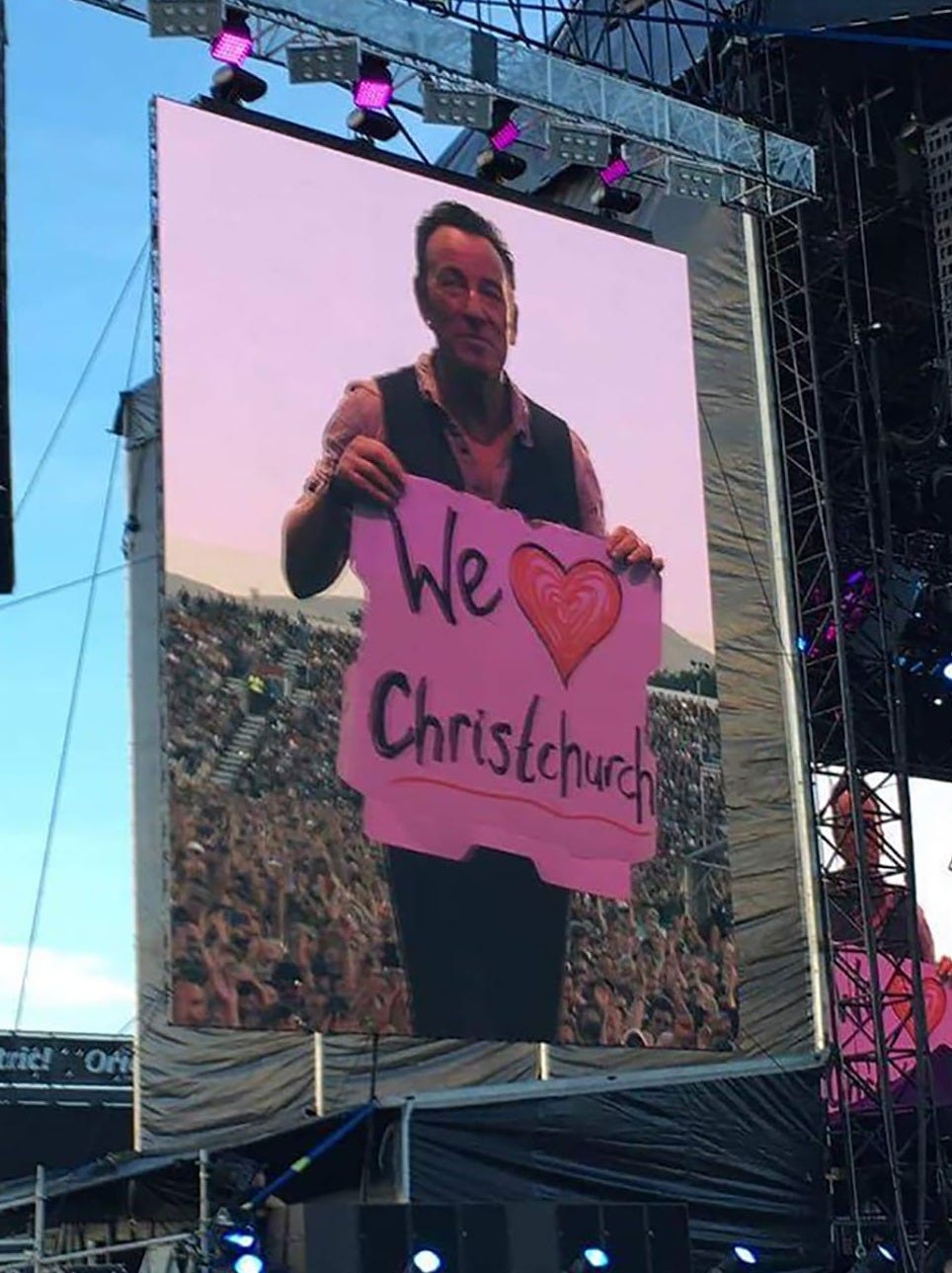
For contrast consider Christchurch. New Zealand loves its Bruce! After the 2011 earthquake that killed 185 people, fans in the city begged him to come play. He finally made it down in 2017, playing a ten-minute version of “My City in Ruins” that left “many tear-stained faces” in the soldout stadium crowd. Today a rebuilt Christchurch is having a moment. It’s where Kiwis move when they’re not moving to Australia. When the violence lasts only ten seconds and ain’t even human, a community can eventually rise up.
Not America, not yet. We’ve got some fighting to do. Choose your Springsteen.
The Rising is The West Wing, a shimmering liberal mirage of victory. The Rising is the last gasp of The End of History. The Rising is a podcast with Obama. The Rising is Uncle Bruce giving you a hug and a hammer and ride to the Habitat for Humanity jobsite. The Rising believes America—place, people, and ideal—will prevail.
“Streets of Minneapolis” is Andor and One Battle After Another, a struggle both righteous and grimly endless. “Streets of Minneapolis” is This Machine Kills Fascists and Hasta La Victoria Siempre. “Streets of Minneapolis” knows we won’t ever win, not for keeps. Not in America, not anywhere. “Streets of Minneapolis” accepts there will be blood. Honors that blood. Makes the blood taste good.
One’s half a dream, half a lie. One’s a truth too dark for a dad to face every day.
The bloody mist exists so that one day there will be no more bloody mist.
I drive through a new countryside now. Green paddocks. Stony rivers. No aspens. Aotearoa’s native trees don’t change their color, and the transplanted gums and pines don’t either. In the minvan I listen to Ezra Klein. Gotta have something to tell my Kiwi mates who ask what the hell is going on up there.
We’re sinking into the mist, is the best I got. How far and how fast, god only knows.
The mist will come here too, one day. The mist is everywhere.
At the gym I hop on the treadmill. Enough Ezra. Gimme Bruce. “City of Ruins” is too slow. The Rising kicks off with “Lonesome Day.” Gimme the lie, gimme the dream:
It’s alright / It’s alright / It’s alright / Yeah
It’s alright / It’s alright / It’s alright / Yeah
It’s alright / It’s alright / It’s alright / Yeah
It’s alright / It’s alright. //
Saturday’s live acoustic version is so much better I almost rewrote the whole post.
I’m cutting Countin’ on a Miracle, Worlds Apart, Let’s Be Friends, Further on Up the Road, The Fuse, and Mary’s Place. Mary’s Place is AI slop Bruce before we had the insult to hand. Off the top of my head I can’t think of a Bruce song I dislike more.
The timing encourages speculation that the song’s original protagonist is a veteran of the first Gulf War in 1991. If so, that would mean Bruce flipped the story of an American war in the Middle East to the story of 9/11 without changing a damn word. The irony is wild.
The Sept. 11 reactions were a weird, uneasy mash of ‘90s multiculturalism and a reactionary Clash of Civilisations. Don Delillo’s 9/11 essay in Harper’s starts out all Us vs. Them and ends up comparing NYC to Mecca. On The Rising Springsteen also tries to bridge the gap: the half-assed world beat of “Worlds Apart” clunks badly but “Paradise,” famously written from the perspective of a suicide bomber, is a 9/11 Nebraska that’s still good-weird and excruciating to hear today.
As the self-appointed Bard of the Boss, I must weigh in here. Agreed, Streets of Minneapolis is not Bruce's best work - but I see as a timely, sincere, thought - and donation provoking. And Trump hates it, so there is that.
As for The Rising: The story goes that in the days following 9/11, Springsteen was driving in - where else? - New Jersey with the top down. Whence stopped for a red light, a driver in the car astride recognized him and said "Bruce, we need you, man". Thus tasked, Bruce contacted producer Brendan O'Brien (known for work with Red Hot Chili Peppers, Black Crowes, AC/DC, Soundgarden, the Killers, Rage Against the Machine and more), said he wanted to work with him. Soon after convened the E Street Band to Atlanta, some ideas for songs in his pocket, and they got to work. I think the album is pretty good, particularly given the specific remit the recording carried and the dark material it dealt with.
I remember the concert you referenced. I was at home in suburban Portland, riveted to the TV, for the biggest collection of music stars since Live Aid, with no commercials, no emcee and very little production value. I loved it.
The show Bruce played in Minneapolis a couple days ago with Tom Morello was rock n roll protest, modern style, and it raised real money for the families of Renee Good & Alex Pretti. I'm okay with it.
you'll have to help parse for me what it means, brother - all i know is that i listened to the Nebraska album a couple times through back to back last weekend. love you.