


Come join my Writing Your Life workshops next month! We’re exploring the weird joy of memoir, in all its forms. We meet in a gin-tasting room in Greytown. It’s a great time.
March 3: The Everyday Haiku
March 10: How to Start a Story
On to the letter. My kids drew me new section breaks. One is named Darcy.

I met an American who’s moving back.
She’s a subscriber to this newsletter, in fact. She came to a workshop of mine last month. We were out on the sidewalk afterwards, chatting in the summer afternoon.
All the usual reasons, she said. Family and schools.
I nodded. I feel the pull, too.1
There was no triumph to her announcement. Her face was open, her eyes searching.
It’s the least certain big decision I’ve ever made, she said.
I wished her godspeed. We hugged, because we’re Americans. Then she walked one way and I walked the other.
To be an American outside the US these days is to be forever searching for an ending.
When does this end, I wanted to yell at the Super Bowl when Jenny turned it on last Monday afternoon. I work hard to hate the self-satisfaction, the player-soldiers trotting back and forth on their endless commutes, the sideline’s corporate ladder in matching Republican khakis. But football on TV is an old childhood dream. I got sucked back in and the NZ weekday disappeared. I got all choked up when Bad Bunny spiked the football and then we turned off the second half and I walked around the empty house in a daze listening to the cicadas roar outside and wishing my kids would learn Spanish like Jenny and I did. Like all Americans should. Like all Americanos in the hemisphere. But now we’re not in that hemisphere and so my kids won’t. Seguimos aquí. The End.

Here’s another ending. A mate and I went to the Nick Cave show in Wellington last week. Nick stood up there in his sweaty black suit and jet black hair and dedicated a song to Elvis freakin’ Presley. I half expected the Kiwi audience to boo, but they didn’t. Many were older than me. They knew us when we were cool.
Nick Cave is older, too. He’s a gothic freak who’s long loved us Americans for the gothic freaks we truly are. His current show is a soaring American-style gospel revival that includes a showstopper ballad about the electric chair2; in his next life our man is coming back as a Flannery O’Connor story. His Elvis song was Tupelo, named for the Mississippi town where the King was born. It’s an oldie, from way back in 1985; I swear he played it just to see if it still walked a Biblical forty years later. Elvis was “a hero of mine,” Nick said. Was that a weariness in his voice, a note of doubt? What’s the King’s present-day exchange rate?
Tupelo’s a thumper and the Bad Seeds hammered it like they were tearing the temple down. Looka yonder / A big black cloud come! I bopped in the dark and knew, just knew, that I was witnessing the last song any performer on the TSB Arena stage would dedicate to Elvis Aaron Presley (1935-1977). The End.

Nick Cave is, in his Australian way, an avatar of American soft power.3 Hell, so is this newsletter. But soft power is the think-tanky 30,000-foot view, a vague roll of national thunder. On the scale of a single human life, a single human family—the only scale on which we can make those big decisions—soft power is much harder to calculate.
When we were living in China they built concentration camps for the Uyghurs. A million, maybe 1.5 million of its own citizens were locked up for brutal ‘reeducation,’ their children stolen, their mosques and cemeteries and ancient cities razed to the ground, their great writers disappeared. We squirmed, but we had good jobs and new babies; we stayed until the pandemic pushed us out.
Now ICE is buying up warehouses to do the same in America. One’s in Surprise, Arizona, not far from where I grew up. There’s an absolute death star outside Dallas set to lock up 9,500 souls just down the freeway from where my father was born. For the second time in our family life, ‘concentration camps’ enters our where-to-live decision tree. But this time it’s home.
When a fellow Texan came by the house last weekend, driving home from a camping trip in the Tararua Range, we drank our tea and talked of moving back. It’s a familiar party game. We run the numbers, the worries. Obamacare til the job kicks in, but what job? In what distant suburb could we afford a house?
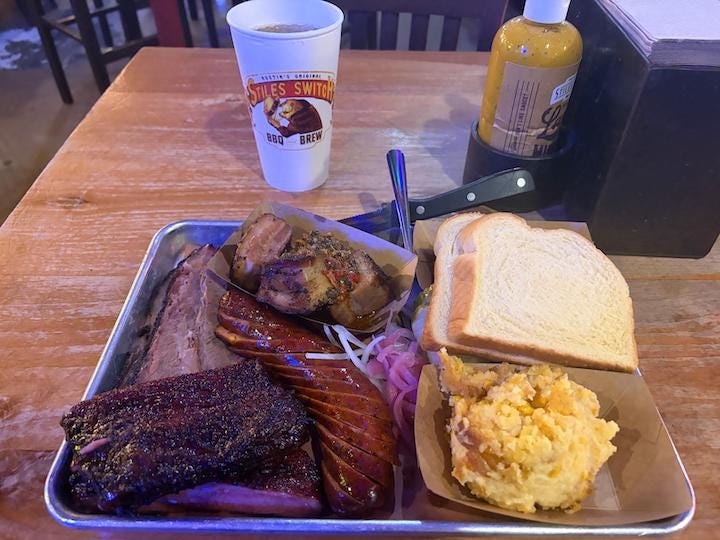
New Zealand’s an ending, and a good one. But we keep the door propped open, the breeze of home blowing through. China was more than camps, and Texas too. Texas is my brother-in-law sending a photo of an absurdly stacked BBQ plate. Texas is a video of my nephew in his junior high basketball game, dropping a sick crossover as he drives to the hoop. Texas is family and schools.
Americans down here have a Facebook group. I’m a dedicated lurker. It’s a kind place. There are regular tips on finding Mexican food and Benadryl and tax lawyers. Say you’re moving here and folks pour out the advice. Say you’re new and folks clamber to meet up. Say you’re lonely and cold and Kiwis don’t talk to me, not like talk talk, and the group’s NZ lifers say it’s alright, moving anywhere takes time, the loneliness will end.
When someone posts to say they’re moving back—family and schools—sometimes another leaver will pipe up from back in the States to say I feel ya, honey. The rule is that if you leave New Zealand, you’re supposed to quit the group. But enforcement is voluntary. The leavers linger as long as they need.
There’s another Facebook group for Americans who are moving to New Zealand but haven’t landed here yet. Also a nice place, but with a whole different energy. New Zealand here is a shining future, a party invitation. There are introductions with smiling family photos, and so many questions. Advice on moving pets across the sea? Tips on Christchurch schools? Does New Zealand have dishwashers? T minus one week til we’re in Aotearoa!!!
They seem pretty certain.

After the Nick Cave show, me and four Kiwi dads found ourselves in a half-empty cowboy bar.4 The bartender was a young woman with black hair and empty eyes. I caught her accent straightaway.
Where ya from?
Boston, she said.
Austin?
Boston, she said, and our summit was done.
There was no line for the bull. I climbed up and wrapped the rope around my hand once, then twice, like they do in rodeos back home. I sat up straight and proud. I raised my free hand high. Real cowboys don’t touch the bull. I gazed out across the bar, silent except for the screaming hip-hop. Kiwis do not cheer, they do not yell woo.
Seated at the bull controls was the bartender from Boston. She did not meet my eye. She twisted the knob and the bull began to roll. I held tight. I felt good up there. Then Boston twisted the knob again. The bull gave one quick jerk and I tipped over like a teapot and began a long, slow slide down the bull’s vinyl flank. I white-kunckled that rope. I would not go easy. I kept my free hand high, waiting for applause or forgiveness or release.
Boston waited, too. I guess that’s her job.
I let go and fell to the mat. We dads downed our beers and went up the street for Chinese. Hundred bucks says the bar’s closed inside a year. //

On the move from China, and the uneasy soft power of American country music:


Opening a can of worms here. American parents here have two main critiques of NZ schools, issues I’ve heard raised by some Kiwi parents, too. 1) Neurodiverse students can’t always get the support they need, and 2) The schools are not rigorous enough. Both complaints have some root in infrastructure: many schools here simply offer less than the schools we’ve left behind, whether that’s honors classes or extracurricular activities or help for different styles of learning. There’s also a cultural side. Broadly speaking, Kiwi society puts a stronger premium on the community over the individual. This is great in many ways, and a true relief from cutthroat American “meritocracy.” Everybody’s good enough, is the vibe; no need to push the bright kids any higher. Plenty American parents here think this is great. I go back and forth. I’m an American, y’all. I was born to raise tall poppies! But this should all probably be its own letter one of these days.
The Mercy Seat, from 1988’s Tender Prey. Johnny Cash’s late-career cover is definitive, and uncontestable proof of Nick’s adoptive American-ness. The Man in Black sings your song, you’re in the club.
Nick himself, in 2024: “I’ve always loved America — it’s the country I love most of all, in a way.”
Wellington has no cowboys.
Wellington has no cowboys
Wellington has no cowboys,
the poppies aren’t as tall.
Auckland has a beach or two,
but no Vegas or mega mall.
Christchurch has a cathedral, though
it’s pretty much a ruin.
Dunedin has little penguins;
I hope to see them soon.
A house here costs a fortune;
don’t ask about the rents.
But there’s a kiwi on the dollar coin,
and it costs just sixty cents.
interesting read as an american who has left, returned, and is leaving again (though the previous moves were on a smaller scale). solidarity with all y'all!