

Place is the New Art
On The Cats of Gokogu Shrine

Kia ora whānau! I’m reemerging from my PhD-induced coma with all sorts of crazy dreams. First, some news—
Sunday 9 August: Write Your Welly Life
The great Leah McFall and I are throwing a writing workshop Aug. 9 at the Southern Cross in Te Aro. It’s called Write Your Welly Life because that’s what we’re going to do! We’re rolling from 3-4:30 p.m. and tickets include snacks and a drink. We’ve got just a few seats left, so click here to reserve yours. Come join!
A New Plymouth Odyssey
We lost my son for a wild three hours over the holidays. We were in New Plymouth, a lovely city none of us had ever been in before, but my dude just took his bearings by the city’s famous Wind Wand and then walked 3km back to our motel. I could not be more proud of him—or of the city that gave him the landmark to follow. Wrote it all up for The Spinoff here.
Now, to the letter—
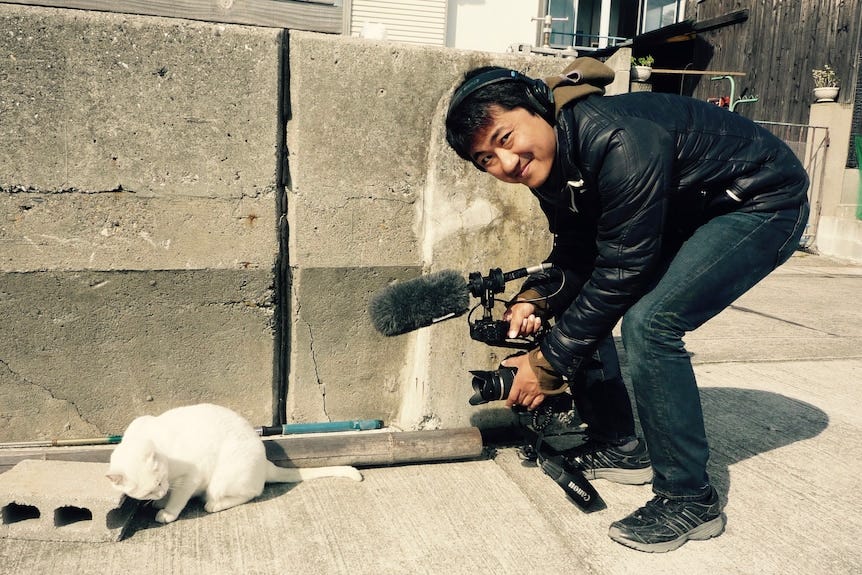
Last weekend we took the kids to see The Cats of Gokogu Shrine at a community film screening in Carterton. It’s an '“observational documentary,” as director Kazuhiro Soda calls his work. The story: A bunch of stray cats live at a small temple in Japan. The locals debate how to deal with the population. Time passes. Old men fish. That’s about it. At one point director Kazuhiro Soda sits us through a magnificently interminable meeting of temple volunteers doing budgets on a white board. You feel like you were there, man, and you start wondering if it’s ever going to end.
Then about halfway through the film [spoiler, I guess?] the lion mask appears. We’re out in a now-familiar lane near the temple. In the middle of the street, with no explanation, stands a man or woman in a red-and-black lion mask of carved wood. I believe it’s a Shinto ritual, but the movie doesn’t explain so I won’t either. The lion wears crisp robes of white and navy. A second person follows behind, carrying the lion’s tail. The already slow movie suddenly stands still. So did my heart.
From then on I hung on Soda’s every long meandering take—cats, more cats, neighbourhood gossip, cherry blossoms—then drove my family home in a deep spell of joy. Life is beautiful.
I can’t stop thinking about this.
Most days it feels like everything is shrinking.
Most days it feels like everything is melting away into content.
What’s everything? I don’t know. Thought, experience, wisdom, product. Any idea too big and too mysterious to be digestible in social media feels quite suddenly like it’s not a real idea at all. A passing shadow, maybe. A dream.
There’s a mystery to life that a film or a big pile of words can only suggest.
Jenny’s rereading Bolaño’s Savage Detectives now, one of those novels that feels realer to me than long stretches of my own life. I don’t know what realer means here, exactly. My soul does. But souls don’t spell things out.
When I say realer I think I’m talking about art. The good stuff that hits. Soda’s film, Bolaño’s novel.
Soda’s shot of the lion mask begs me to throw in ritual, too. Works for me. Church was a great source of mystery for me as a kid. That’s gone now, too.
Sam Kahn recently wrote a convincing summary of several of the various arguments out there that the internet is the end of art. Not the end of making it, but the end of the time and space we need to experience it. This is Kahn’s own explanation for why Substack is a great place to argue about fiction but not to actually read it:
[T]he infinite scroll is assembled in such a way that we always seem to be on the verge of hitting something that’s of importance to us and we never quite reach the stage of boredom that allows us to enter willingly into fantastical space.
The same equation holds for ritual. I can’t believe in the lion mask if my mind’s on the scroll.
Soda’s film, then “bores” us in order to drag us through the noise and out into the fantastical space on the other side, where neighbours dress as lions and budget meetings turn to art.
Funny, then, that The Cats of Gokogu Shrine is about the least fantastical film you could ever see. It’s mostly volunteers gentling trapping strays in small-town Japan. Still, the trick works. Our souls rose up from the stackable chairs of a community film club in small-town New Zealand and settled again, for two hours, in another real place.
That night after the film I lay awake wanting badly to film, like, our local stretch of the Waiohine River for like an hour straight, one take, no breaks, just local water over local stones, and then—what? Upload it somewhere?
I suppose you could make art and share it nowhere. But we’re not monks locked away in abbeys. Silence is only sacred if you make some noise afterwards, and anyhow we’re lonely enough as it is. The volunteers of Gokogu Shrine all have day jobs.
For me, now, one answer is to make things about place.
PLAAAACE, as Jenny says whenever I ramble on like this. She’s an anchored soul. Her parents still live in the house she grew up in.
But hear this wanderer out: Places are their own mystery.
They’re not quite a ritual, with fixed rules and creeds. They’re not quite an art, reflecting one individual’s executed vision and expression.
Places are unfixed bundles of collective ideas and feelings and histories that no one human soul could ever sort.
Places do not transmit easily in the flavour packets of social media. Places sit and stew. Places do not dance on cue.
Place is Kazuhiro Soda filming stray cats and budget meetings and Shinto ceremonies for two years simply because they’re next door and alive. Do we need another reason? //
Special bonus Soda-inspired Wellington content for writeyourwellylife.nz. Hope to see you there!
I'll see you Sunday - Look forward to meeting you! :)
Oh how terrifying! Yay for the happy ending. About 30 years ago there was a kid in Auckland who ride his trike about 8km to see his Grandma, he didn’t tell anyone. He was quite cross with all the “yay he’s been found” stories (his route was published in the Herald) because he insisted he wasn’t lost.